Journal · field notes from the gateway
Sorong Sea States by Month
Sorong’s weather headline is genuinely good — the gateway sits in the cyclone-free equatorial band, so the catastrophic risk that shapes seasons elsewhere simply does not apply. The…
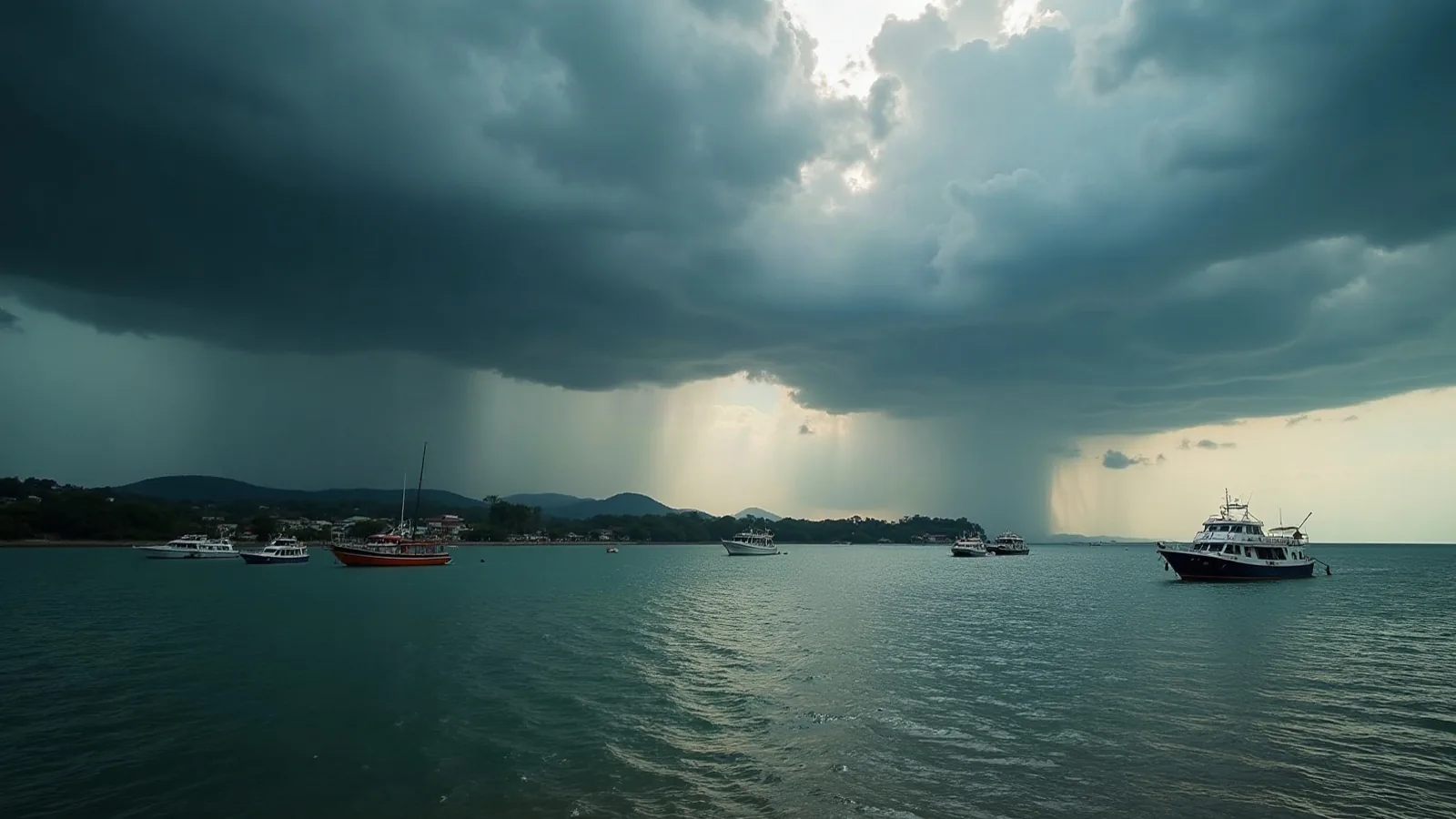
Sorong’s weather headline is genuinely good — the gateway sits in the cyclone-free equatorial band, so the catastrophic risk that shapes seasons elsewhere simply does not apply. The honest fine print: monsoon seasonality still runs the year, the southeast season pushes persistent chop into exposed water around mid-year, squalls are a year-round tax, and ‘cyclone-free’ has lulled more than one crew into treating the roadstead casually. Here is the month-by-month shape, stated as tendencies rather than promises.
Why there are no cyclones, and what that buys
Tropical cyclones need distance from the equator to spin up; Sorong sits too close for them to form or track nearby. This is structural, not statistical luck — and it buys the region something rare: no season in which a yacht must simply be elsewhere. Insurance geographies, passage plans and charter calendars all relax accordingly. What it does not buy is calm water on demand, and the rest of this page is the difference.
The two-season engine
The year runs on the monsoon alternation. The northwest season — roughly the turn of the year — brings its wind from the north and west with rain pulses and convective squalls. The southeast season — roughly May through October — sends steadier trade-wind flow from the south and east, and with it the persistent swell and chop that mid-year is known for in exposed water. Between them sit transition months where the engine idles and the flattest water often lives. Every one of these boundaries blurs in practice; the engine is real, the calendar approximate.
Month by month, honestly hedged
December to March: northwest influence — squally, rain-pulsed, but with genuine calm spells between systems; anchorage comfort on the Sorong side is generally reasonable. April: transition, frequently kind. May to September: the southeast push builds and holds — expect more consistent wind and working chop, wetter tender runs, and barge operations that choose their days. October: the push relaxes; November: transition again, often flat and hot. Any given week can contradict its month, which is why operations here plan by forecast and use the season only for context.
Squalls: the year-round constant
Independent of season, convective squalls are the weather event a Sorong yacht actually meets: a dark line, a wind spike to thirty knots or so, a drenching, and an hour later the same afternoon you had before. They matter in three places — at anchor (the dragging risk covered in our anchoring etiquette piece), during transfers alongside, and on tender runs with guests aboard. The defence is identical in all three: watch the sky, respect the line, delay the run. Squalls cost minutes when respected and gelcoat when ignored.
What sea state does to port operations
The operational translation of all this: fuel barges and tank boats work comfortably in the calm spells and slowly or not at all in a fresh southeast afternoon; tender runs from the anchorage go from pleasant to wet-but-workable; wharf windows care more about surge than wind. The staged-operations logic that runs through the berthing page exists partly for this reason — operations booked with weather margin slide gracefully, while same-day improvisation meets the afternoon chop head-on. Morning remains the operational gold hour year-round.
Passage timing to the park
The Dampier crossing responds to the same engine: more comfortable outside the peak southeast months, and better in the morning than the afternoon in any month, before the sea breeze stacks the chop. None of this closes the crossing in any season — liveaboards run it year-round — it merely prices the comfort. Passage planning from the gateway, with the clearance and logistics sequencing that precedes it, is the wider subject of the passage-planning gateway guide; the weather layer here is one input to it.
Forecast sources and the ground-truth layer
Global models — the GRIBs every navigator already pulls — perform usably in the region and miss what global models always miss: the convective afternoon, the local acceleration, the squall line that formed an hour ago. The calibration layer is local and current: what the barge operators decided this morning, how wet yesterday’s tender runs were, what the ferry crews are saying. The desk passes this layer on plainly when staging operations, because a forecast plus the port’s actual morning beats either alone.
Planning with honest weather
The summary a passage planner can use: no cyclone season, ever — plan any month. Flattest odds in the transitions; most persistent chop mid-year in the southeast push; squalls always, everywhere, briefly. Book port operations with margin, favour mornings, and let the desk’s ground truth calibrate your GRIBs when the schedule is tight. Sorong’s weather is among the most forgiving in the tropics — it asks only that nobody mistake forgiving for flat.
Frequently Asked Questions
Does Sorong get cyclones?
No — the region sits close enough to the equator that tropical cyclones do not form or track here. That is the genuine good news. The honest caveat: cyclone-free is not weatherproof; monsoon seasonality still sets sea states, squalls and anchorage comfort.
When is the calmest season around Sorong?
Broadly, the transition months and the northwest-season lulls bring the flattest water on the Sorong side, while the southeast season (roughly mid-year) sends more persistent trade-wind swell and chop into exposed water. Local effects modify everything — treat months as tendencies, not guarantees.
What weather actually disrupts yacht operations here?
Squalls — short, sharp, thirty-knot affairs — and persistent seasonal chop that makes tender runs and barge operations slow or wet. Rarely anything dangerous to a prepared vessel; frequently something that costs a day.
Should passages to Raja Ampat be timed by season?
The Dampier crossing is more comfortable outside the peak southeast push, and afternoon sea breezes argue for morning crossings year-round. Sound passage planning beats season obsession: the windows exist in every month.
Where does reliable forecasting come from?
Global models cover the region usably; local knowledge calibrates them. The desk passes on what the port is actually seeing — which barge operators sailed, which tender runs got wet — as the ground truth layer under the GRIBs.
Send this first
LOA and flag, ETA Sorong, last port, crew and guest count. The desk answers with the sequence, not a brochure.
WhatsApp the desk