Journal · field notes from the gateway
Anchoring Etiquette in Sorong's Working Roadstead
Anchoring etiquette in Sorong reduces to one principle: this bay works for a living, and the yacht is its guest. Ferries keep schedules, traders load and sail, fishing…
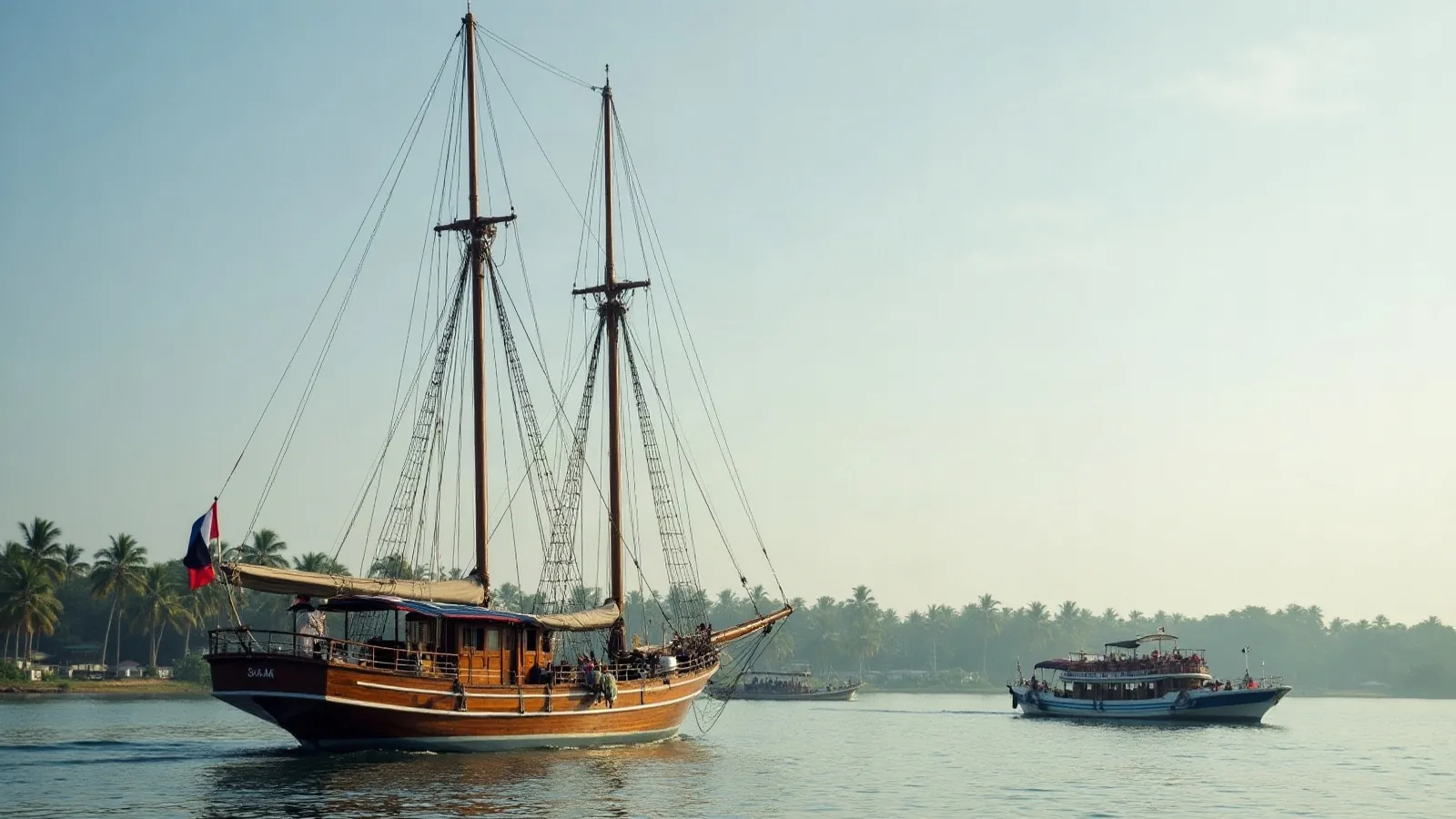
Anchoring etiquette in Sorong reduces to one principle: this bay works for a living, and the yacht is its guest. Ferries keep schedules, traders load and sail, fishing boats stream out at dusk — and none of them planned their day around your swinging circle. Choose water no one needs, light the boat properly, keep a real watch, and the roadstead will treat you the way it treats the patient: perfectly well.
Read the bay before dropping
Twenty minutes of observation before anchoring repays itself for days. Watch where the ferries actually run — not where the chart suggests they might. Note which wharves have traffic working them, where the small boats stream to and from, and where other vessels lie to anchor with evident local knowledge. The picture that emerges is a map of water-in-use, and the correct anchorage is the negative space: close enough to the city for the tender run, far enough from every working lane that no one ever has to alter for you. The wider layout is sketched on our Sorong berthing options overview.
The swinging-circle discipline
Roadstead anchoring means scope, and scope means swing. Calculate the circle honestly at full scope, add the neighbour’s circle to the arithmetic, and remember that squalls back the wind around faster than an anchor watch expects. The classic Sorong error is anchoring tight to another vessel in a flat evening calm and discovering at 0300, in thirty knots of squall, that two circles have become one. Space is free here; use it generously.
Lights, shapes and being seen
An anchored yacht in a working roadstead is a hazard to be marked, not a right to be assumed. Anchor light bright and actually working, the ball by day, and AIS transmitting — local commercial traffic does watch screens, even if the fishing fleet does not. On dark nights consider deck lighting that makes the hull’s extent obvious; a masthead light alone reads as ambiguous at close range against city glare, the same visual problem described in our night-entry piece from the other side of the bridge.
Squalls: the roadstead’s honest weather
Equatorial squalls are short, sharp and democratic — they hit every boat in the bay at once. The anchored yacht’s defence is preparation: ground tackle set hard and backed down on, chafe gear where it belongs, and someone aboard whose actual job is noticing. Thirty knots for twenty minutes is routine; it drags the unwatched, not the well-set. If the forecast turns genuinely ugly, the answer is sea room or a better-sheltered arrangement, discussed with people who know the local options — not more scope and hope.
The neighbours, and how to be one
Roadstead courtesy is mostly common sense. Give working vessels first claim on convenient water. Take the tender wake down a notch passing moored lines. If a trader’s manoeuvre needs the space you occupy, moving cheerfully costs ten minutes and buys goodwill the whole port remembers — this is a city where harbours talk. And the courtesy runs both ways: an anchored yacht that behaves like a professional gets treated like one, from the wharf offices to the fuel suppliers whose drum boats will be alongside you tomorrow.
Leaving the boat: honesty about risk
Crew runs ashore are the point of anchoring off a city; abandoning the boat all day is a different decision. The compounding risks are weather arriving unwatched, tenders and traffic passing close, and the simple fact that nobody ashore is answerable for your topsides. Watch rotations solve it aboard; arranged watchkeeping solves it when the whole crew has reasons ashore — a service the desk coordinates routinely for vessels waiting between trips, as covered in the between-trips waiting guide.
The formalities of floating
Anchoring does not exempt a vessel from the port’s paperwork: dues attach to the stay, clearance status must be current, and the harbourmaster’s rules on notification apply to movements within port limits. None of this is heavy — the amounts are modest and the logic is covered in our invoice-lines explainer — but the yacht that anchors, clears in properly and pays its lines is operating; the one that hopes to float unnoticed is accumulating a problem. In a port this size, unnoticed is not a real category.
The short version
Observe first, anchor in the negative space, swing with margin, light the boat like you mean it, watch the weather, move graciously when work needs the water, and keep the paperwork current. Do those seven things and Sorong’s roadstead is exactly what a Raja Ampat-bound yacht needs it to be: affordable, convenient, and completely uneventful. The desk is one message away when any of it needs arranging — in USD, stated plainly.
Frequently Asked Questions
Where should a yacht not anchor in Sorong?
Clear of the wharf approaches, ferry lanes, and any water that local traffic obviously uses as a road. If your swinging circle could inconvenience a vessel that works for a living, you are in the wrong spot — move before you are asked.
Is holding good in the roadstead?
Variable — sand and mud patches hold well, but depths shelve unevenly and there is debris near the working areas. Set properly, back down hard, and treat your position for the first hours as provisional.
Do local boats give way to an anchored yacht?
An anchored vessel has its rights, but rights argue poorly against a loaded trader at night. Anchor defensively: proper lights and shapes, AIS on, and a position that never forces the question.
Can we leave the yacht unattended at anchor?
Briefly and thoughtfully, yes; routinely and casually, no. Squalls arrive fast, and an unwatched boat in a working roadstead is trusting strangers with its topsides. Watch rotations or arranged watchkeeping are the honest answers.
Is there a fee for anchoring?
Official port dues apply to a vessel’s stay in port waters whether alongside or at anchor — modest, receipted, and part of the clearance arithmetic rather than a separate anchoring toll.
Send this first
LOA and flag, ETA Sorong, last port, crew and guest count. The desk answers with the sequence, not a brochure.
WhatsApp the desk