Journal · field notes from the gateway
Haul-Out and Repairs for Yachts Near Sorong
What can and cannot be repaired near Sorong: commercial slipway realities, diesel and steel work, underwater services, imported parts, and how to run an emergency defect properly.
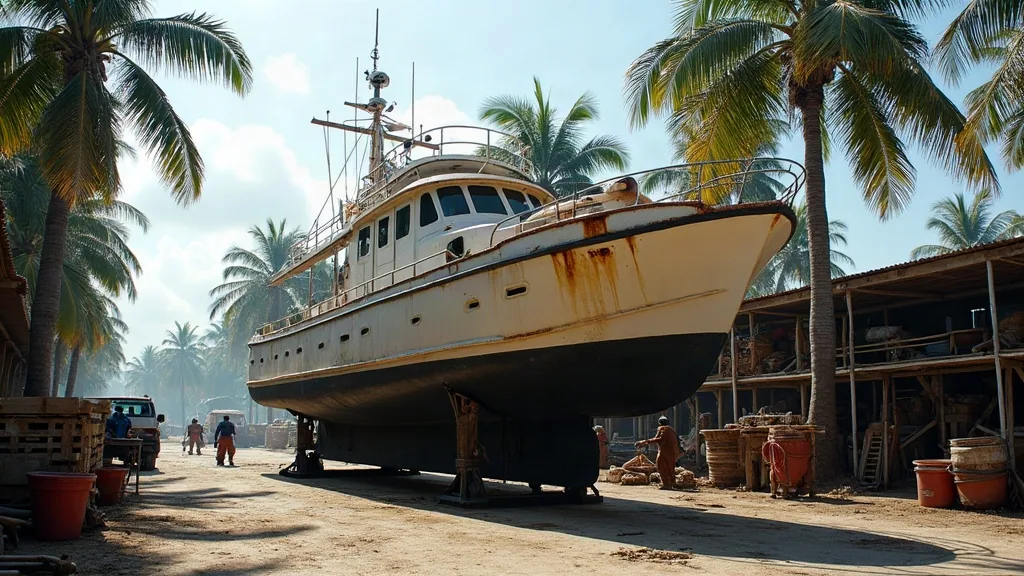
Sorong has a working boatyard culture built around steel fishing vessels and coastal traders, and no yacht yard at all. That is an important distinction, not a pedantic one. A steel workboat with a flat run and heavy plating can sit on a commercial cradle without ceremony. A yacht with a fine underbody, a bulb, exposed shafts and struts, a soft topsides finish and thin plating needs blocking designed for it — and that is not what a commercial slipway carries.
Understand what a commercial slipway is
Sorong’s haul-out capability exists to serve the fishing and coastal fleet. Expect a slipway or marine railway, cradles and blocks sized for commercial hulls, pressure washing, scaffolding, and a working environment with welding sparks, grinding dust and vehicle traffic. The people are competent at what they do all day: steel, welding, shafts, rudders, propellers, antifouling on robust hulls.
What is not there: purpose-built yacht blocking with adjustable pads, a controlled painting environment, gelcoat and awlgrip finishing to yacht standard, a travel lift sized and slung for a yacht hull, or a yard culture that treats a topsides scratch as a serious event. If your vessel needs those things, the honest recommendation is a passage to a facility that has them rather than a compromise in Sorong.
When a Sorong haul-out is reasonable
- Steel or aluminium expedition vessels and support craft with commercial-style hull forms
- Indonesian-flag phinisi and wooden liveaboards, which the local trade understands well
- Emergency work where the alternative is a long passage with a damaged vessel
- Underwater damage assessment where the vessel must come out to be seen properly
When it is not
- Scheduled maintenance on a composite or finely finished motor yacht
- Anything involving topsides paint or gelcoat to yacht standard
- Work requiring class or manufacturer supervision that cannot be arranged locally
What in-water work is available
A great deal, and this is where Sorong is genuinely useful. Commercial divers are available for hull and propeller cleaning, rope and net clearance, anode replacement, sea-chest and strainer clearance, running-gear inspection and photographic damage assessment. For a liveaboard operating in Raja Ampat’s productive waters, regular in-water hull cleaning is preventive maintenance rather than cosmetics: fouling costs fuel, and a fouled hull in strong currents costs more than fuel.
Rope and net around a propeller is the single most common in-water job in this region, and it is worth carrying decent underwater cutting equipment aboard so the crew can deal with it away from port. Note that diving on your own vessel inside the marine protected area is subject to the same rules as any diving there.
Topside and machinery repairs
Sorong supports diesel engineering properly. Main and auxiliary engines, injectors and pumps through local workshops, cooling systems, exhausts and mounts, generator ends, starters and alternators, hydraulic hose making and seal work, pumps of all descriptions, and steel and aluminium fabrication and welding. Standards are workmanlike. Supervise anything that will be visible, specify tolerances explicitly, and expect a functional finish rather than a cosmetic one.
What is not supported locally: navigation and communications electronics, radar and autopilot, satellite systems, stabilisers, marine air conditioning and chilled water, watermaker high-pressure pumps and membranes, proprietary engine control modules, and anything needing a manufacturer-authorised technician. For those, a specialist flies in from Bali, Jakarta or Singapore with the part. Plan several days once flights, availability and customs handling are accounted for — details on our technical support page.
Getting parts into Sorong
A yacht in Indonesia under temporary importation needs correct customs treatment for incoming spares. Parts sent as ordinary passenger baggage or unmarked freight are frequently held, and the delay usually exceeds the value of the component. The right approach is to prepare the paperwork before the part ships, declare it against the vessel, and clear it properly on arrival. This is routine work for an agent and a recurring source of frustration for crews who try to shortcut it.
Running an emergency defect properly
- Establish safety first. Is the vessel safe where it is? Does it need to move? Are guests aboard? Everything else follows from that.
- Diagnose before you dramatise. A large share of catastrophic-sounding failures turn out to be fuel contamination, blocked filters, a failed sensor or a loose connection. Confirm the fault before ordering a part from three thousand kilometres away.
- Classify the repair. Local, local-with-imported-part, or specialist-flown-in. Each has a very different timeline and cost, and the client deserves both numbers before choosing.
- Notify who needs notifying. Structural work, major machinery repair and anything after a grounding or collision normally involves class, flag or insurer. Skipping that step in a remote port is how a repair becomes a claim dispute.
- Supervise the work. Dropping a contractor on deck and leaving is not project management.
Prevention beats haul-out
For fleets working Raja Ampat, the highest-value technical work happens in the turnaround window at Sorong: filters, impellers, anodes, hull and prop cleaning, tender and outboard servicing, compressor filter changes, generator servicing. None of it is glamorous and all of it prevents a mid-charter failure at an anchorage six hours from anywhere. We build that list into the turnaround schedule precisely because it is the work that never happens unless somebody schedules it.
Frequently Asked Questions
Is there a haul-out facility for yachts in Sorong?
Sorong has commercial slipway capability serving steel fishing vessels and coastal traders, with cradles, blocks and working practices sized for commercial hulls. It is not a yacht yard, and vessels with fine underbodies, bulbs, exposed running gear or yacht-standard finishes should generally plan a passage to a proper yacht facility.
What underwater services are available at Sorong?
Commercial divers handle hull and propeller cleaning, rope and net clearance, anode replacement, sea-chest and strainer clearance, running-gear inspection and photographic damage assessment. Regular in-water hull cleaning is genuinely preventive for vessels working Raja Ampat's productive waters.
Can spare parts be shipped to a yacht in Sorong?
Yes, but a vessel under temporary importation needs correct customs treatment for incoming spares. Parts sent as passenger baggage or unmarked freight are frequently held. Paperwork should be prepared before the part ships and the item declared against the vessel.
What should be done first when a yacht has a serious defect near Sorong?
Establish whether the vessel is safe and whether it must move, then diagnose properly before ordering parts, since many alarming failures prove to be fuel contamination, blocked filters or a failed sensor. Then classify the repair as local, local-with-imported-part or specialist-flown-in, and notify class, flag or insurer where required.
Send this first
LOA and flag, ETA Sorong, last port, crew and guest count. The desk answers with the sequence, not a brochure.
WhatsApp the desk