Journal · field notes from the gateway
Provisioning and Bunkering in Sorong
What a yacht can actually buy in Sorong: fuel delivery and quality control, the local market, cold chain limits, water by tanker, and what must be flown in from Bali or Singapore.
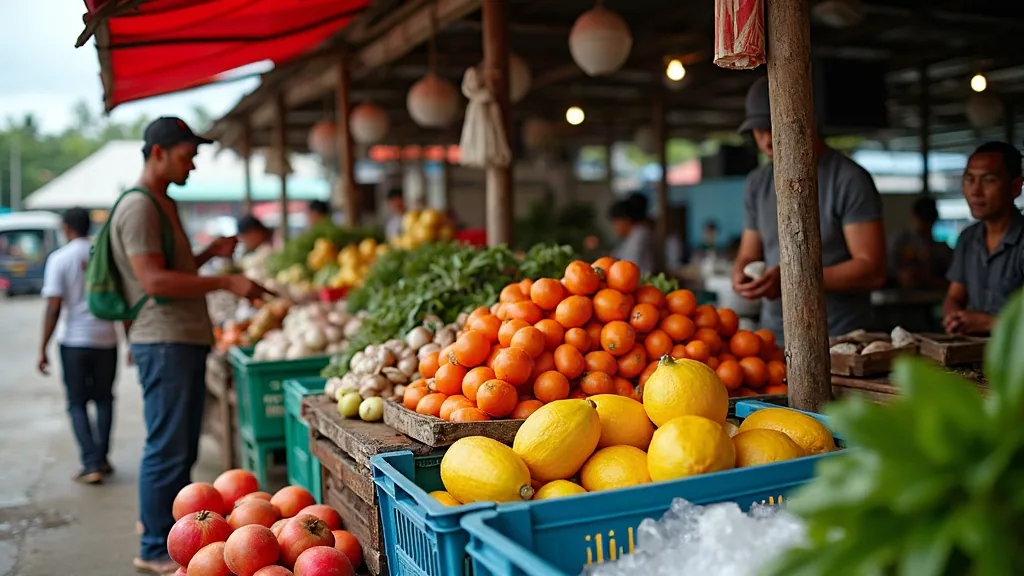
Sorong provisions a liveaboard beautifully and a superyacht galley only partially, and it fuels both by barge or tanker with no dock involved. The distinction matters because it drives the whole logistics plan: what you buy locally, what you import, and how many days ahead each decision has to be made. Get that split right and Sorong is a comfortable supply port. Get it wrong and you spend a week discovering that a case of a particular wine simply does not exist east of Makassar.
Fuel: how it actually arrives
There is no yacht fuel dock in Sorong. Marine diesel reaches a vessel one of two ways. A bunker barge comes alongside, which suits larger volumes and vessels lying at a quay or at anchor able to take the barge alongside. Or a road tanker delivers to a quay and pumps aboard, which suits smaller lifts and requires an alongside slot with road access. Either way the operation is planned, scheduled and confirmed in writing days ahead — volume, grade, method, timing and receiving arrangements all agreed before anyone turns up.
Allow five to seven days’ notice for a substantial lift. Shorter is sometimes possible but it narrows your options rather than expanding them, and a rushed bunkering is exactly the situation in which quality control gets skipped.
Quality control that is not optional
The realistic risk in remote Indonesian bunkering is water and particulate contamination rather than anything exotic. The controls are simple and every vessel should apply them:
- Sample before it enters your tanks. Draw and retain a representative sample from the delivery. If a problem emerges later, that sample is the only evidence you will have.
- Filter and water-separate on transfer wherever the vessel’s arrangement allows it. A portable filter rig pays for itself the first time.
- Watch the meter and the paperwork. Quantity disputes are far easier to prevent than to resolve.
- Do not bunker straight into a hard passage. Taking a lift and immediately setting off into the Dampier Strait currents leaves no margin if filters start blocking. Bunker, run, check, then sail.
Bunkering also brings pollution obligations. Scuppers plugged, drip trays under every connection, absorbent material to hand, a boom where required, and a crew member whose only job is watching the connection. A spill in Indonesian waters is a serious matter and its consequences outlast any itinerary.
Water: tanker, container, or make your own
Potable water is delivered by road tanker to a quay or ferried out in bulk containers. Quality is adequate for tanks and machinery, and the sensible approach is to treat it as tank water rather than drinking water — filter it, chlorinate to your normal standard and carry bottled water for the galley and guests. Volumes are limited by tanker capacity and by road access, so a large lift means several trips over several hours; state your requirement in cubic metres when you book, not on the day.
A vessel with a healthy watermaker has a real advantage in this region. Arrive with tanks low, top up modestly from shore, and make the rest at sea in clean water away from the harbour.
What Sorong provisions genuinely well
The market is the port’s underrated asset. Tropical fruit in quantity and variety, vegetables and root crops, eggs, rice, noodles, spices, dry goods, and fish landed locally in a working fishing port. Prices are ordinary local prices. For a liveaboard feeding thirty or forty people on Indonesian and pan-Asian menus, this is a perfectly capable provisioning port and there is no reason to import the bulk of the list.
Practical tips: shop early in the morning for the best fish and produce; buy fruit at varying ripeness rather than all at once; and send a crew member who knows what the galley actually wants rather than sending a list to a driver. Supermarkets cover packaged goods, cleaning products and basic toiletries.
What Sorong cannot provision
European cheeses and charcuterie. Dry-aged or premium cuts of beef. A wine and spirits list of any depth. Specialist dietary lines — gluten-free, vegan speciality, low-FODMAP, medical nutrition. Branded infant formula. Pharmacy items beyond the basics. Specific brands of anything.
These come from Bali, Jakarta or Singapore, flown in, with proper customs handling and a planned cold chain. Two weeks’ lead time is a realistic working assumption once you account for sourcing, freight, clearance and last-mile transfer. Any superyacht running a European galley in Raja Ampat should treat this as a normal part of the plan rather than an obstacle — see our superyacht support page.
Cold chain: the part that fails
This is where provisioning in a tropical port goes wrong. Frozen goods that sit on a hot quay, or move in an unrefrigerated vehicle, or wait for a tender that is delayed, arrive degraded even when they still look fine. The discipline is straightforward and must be planned, not improvised:
- Frozen and chilled goods load last, immediately before departure.
- Insulated transport from the source, with the vehicle waiting rather than the goods waiting.
- Straight into the vessel’s own boxes — no intermediate staging on deck in the sun.
- Temperature checked and logged at handover, so a dispute has a fact behind it.
Where an item cannot be moved safely in the time available, the honest answer is to say so and substitute. We would rather tell an operator that a frozen delivery will not survive the schedule than deliver something that spoils on day three of a charter.
Waste is part of provisioning
Everything you load eventually leaves as garbage, packaging, used oil or sewage, and in Raja Ampat none of it may go over the side. Book licensed removal at the same time you book the delivery. Vessels arriving after a long passage with accumulated oily waste should give volumes in advance — this is a service that must be scheduled, not requested on departure morning.
The working plan
Buy fresh and dry locally. Import specialist and frozen premium items from Bali or Singapore with two weeks’ notice. Bunker with a five to seven day lead and sample everything. Take water by tanker but make your own where you can. Load frozen last, land waste before you sail. All of it scheduled into the same alongside window, which is exactly how we run it — see the bunkering and provisioning service and, for dive fleets, the turnaround page.
Frequently Asked Questions
How far in advance should a yacht book bunkering in Sorong?
Allow five to seven days for a substantial lift. Fuel arrives by bunker barge alongside or road tanker to a quay, with volume, grade, delivery method and timing agreed in writing beforehand. Shorter notice is sometimes possible but narrows the available options.
What should be checked when bunkering in Sorong?
Draw and retain a representative sample before the delivery enters your tanks, filter and water-separate on transfer where the vessel allows, watch the meter and the paperwork, and avoid bunkering immediately before a demanding passage so there is margin if filters begin to block.
Can a superyacht provision fully in Sorong?
Not fully. Sorong supplies excellent fresh produce, eggs, rice, dry goods and locally landed fish, but no European cheeses, premium beef, depth of wines and spirits, specialist dietary lines, branded infant formula or pharmacy items beyond basics. Those must be flown in from Bali, Jakarta or Singapore with about two weeks' lead time.
How is the cold chain managed for frozen provisions?
Frozen and chilled goods load last, immediately before departure, in insulated transport with the vehicle waiting rather than the goods, straight into the vessel's own boxes with temperature checked and logged at handover. Where an item cannot move safely in the available time, it should be substituted.
Send this first
LOA and flag, ETA Sorong, last port, crew and guest count. The desk answers with the sequence, not a brochure.
WhatsApp the desk